Bokanovsky's Process
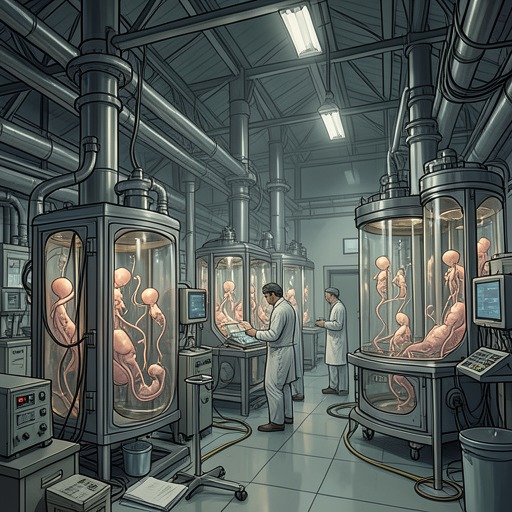
Brave New WorldBokanovsky's Process is a form of controlled human reproduction that multiplies a single fertilized egg into a batch of genetically identical adults. In the World State, this biological standardization supplies workers for repetitive industry and makes the production of social conformity part of the reproductive process itself.
Procedure and Scale
After fertilization, the embryos destined for the Gamma, Delta, and Epsilon castes are taken from the incubators at thirty-six hours to undergo the process. The Director describes it as a series of arrested developmental stages that paradoxically prompt the egg to bud. A single egg can produce between eight and ninety-six buds; each develops into a formed embryo and then a full-sized adult. The result overturns the ordinary principle of one egg, one embryo, one adult: as the Director puts it, the method makes ninety-six human beings grow where one would have grown before.
The technique is integrated into the broader laboratory system rather than treated as an isolated marvel. Fertilized ova are returned to incubators, while the lower-caste embryos are removed early for multiplication. The process thus links reproductive timing and embryological intervention to the World State’s planned allocation of people.
Social Purpose and Industrial Logic
The Director identifies Bokanovsky's Process as one of the major instruments of social stability. Its products are standard men and women in uniform batches, suitable for staffing a small factory with workers derived from one egg. He imagines ninety-six identical twins operating ninety-six identical machines, and describes the system as the application of mass production to biology.
That factory analogy makes the process’s political function clear: it does not merely increase the number of people produced, but makes human sameness useful to an economy built around predictable labor. The intended result is a supply of standardized Gammas, Deltas, and Epsilons, with variation reduced in the very act of reproduction. The Director’s ideal of indefinitely extending the process presents biological uniformity as a solution to social organization, not as a cost requiring discussion.
Stability, Feeling, and Control
The process belongs to a wider system that treats social stability as dependent on the regulation of both work and emotion. The Controller explains that stability requires individuals who are themselves stable and content, because the social machine must continue turning and its workers must remain dependable. In that framework, Bokanovsky’s batches provide an industrial counterpart to the conditioning that keeps people satisfied with their place in society.
The Controller also describes how the interval between desire and satisfaction is shortened so that feeling has fewer opportunities to develop into passion or disturbance. The process’s standardization of bodies and the management of emotional life therefore work in parallel: one organizes people for repetitive roles, while the other seeks to prevent disruptive individual responses. The slogan “Community, Identity, Stability” supplies the official language for this union of biological production and social order.
Contrast with Collective Ritual
The novel sets engineered uniformity beside ceremonies that pursue unity through synchronized participation. At the Solidarity Service, twelve people form a circle, take soma, sing together, and await an imagined Greater Being; the ritual seeks to dissolve separate identities into a collective experience. Bokanovsky's Process reaches toward a comparable image of sameness by a radically different route: not through a shared ceremony, but through the multiplication of one embryo into standardized workers.
The contrast is sharpened by the ceremony’s carefully organized music and collective excitement. Its participants are meant to feel themselves becoming one, whereas Bokanovsky’s Process makes uniformity a material condition of life before those adults ever enter the workforce. Both belong to a society that distrusts isolated individuality, but the process reveals how that preference is built into the World State’s reproductive technology.